
Author: Wuming Chuan
http://oldoakdao.org/blog/about-me/
Zuowang as Refuge
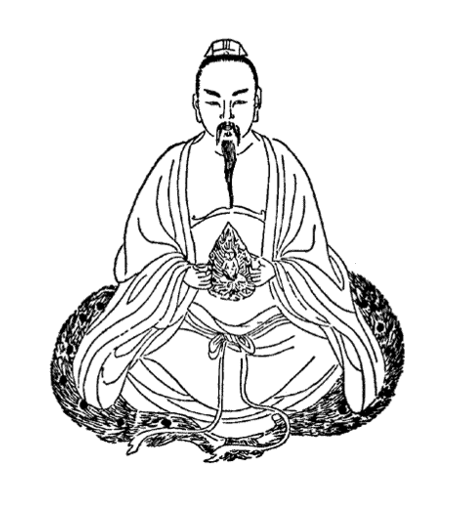
This talk looks at the practice of Daoist meditation in the context of living in affliction. The religious movement of Orthodox Daoism founded in the Han Dynasty recognized that the era of high antiquity was long-gone, so “Chinese Daoism” arose as a practice to rectify humankind and purify polluted spiritual dimensions. Centuries later, Buddhism influenced Daoism in its concern for human suffering, and Daoist tradition further embraced the idea of practice as refuge. Although we can perhaps relate to such a view, this talk presents an older view of meditation not based on the need to solve any fundamental problem. A glimpse into our approach to Zuowang.
Protected: Dao De Jing Chapter 32
Protected: Dao De Jing Chapter 48
Protected: Dao De Jing Chapter 54
Chinese Ghost Festival
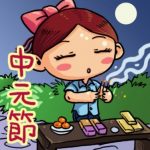
This talk introduces the Chinese Ghost Festival in some of its folk tradition aspects and as it relates to orthodox Daoist practice.
Protected: Dao De Jing Chapter 9
Protected: Dao De Jing Chapter 39
Dragon Boat Festival

Horse Moon is the time of year when annual yang reaches its peak (summer solstice). The tidal hexagram associated with this moon is #44 (Copulation), ☰/☴, which suggests qi rising upward and losing its ground – and being brought back down to earth whether it wishes to or not. Because of the full-throttle nature of this moon, it is considered a precarious and inauspicious time – a time of pernicious heat, when seduction, aggression, and danger abound. Horse Moon is when cavalries in ancient China supposedly would march off to war. While certainly a time to be active, it is also a time to pull back the reins a bit, as unrestrained aggression or exuberance is likely at this time to lead to injury or exhaustion. “Calm down or crash” is the essential qi-message of Horse Moon. Hexagram 44 is about the severe consequences of failing to restrain ourselves – letting ourselves overheat.
Horse is the seventh animal in the 12-animal Chinese zodiac. Because the Chinese recognize the Tiger Moon, rather than the Rat Moon (winter solstice) as the beginning of the new year, Horse is considered the 5th Moon. Five is of course a significant number in Chinese numerology, symbolizing completion and balance – the Five Elements. Five also relates to the emperor, meaning the heart of any particular swirl of phenomena. Doubling a number emphasizes its quality, so the fifth day of Horse Moon – “Double-Five Day” – is considered particularly potent and precarious. This year (2021), Double-Five Day is June 14.
According to Chinese legend, Qu Yuan, a loyal minister in the southern state of Chu during the Warring States period, was a fervent Chu nationalist and poet. When the Chu emperor joined forces with the aggressive Qin emperor, Qu Yuan drowned himself in a lake in despair on the fifth day of Horse Moon. The locals venerated Qu Yuan and gathered in dragon boats to splash the water, beat drums, and drop sticky rice into the water so that the fish would not eat his corpse. The Chinese still celebrate “Dragon Boat Festival” in veneration of Qu Yuan’s loyal character and national pride.
As with most aspects of the Chinese almanac, insofar as it interests Daoist practitioners, calendrical festivals are not merely about celebrating culture but calibrating qi. Observing Double-Five Day thus means entering summer with our eyes open – recognizing the danger of summer heat and watching how excess yang affects our conduct. Things can turn for the worse quickly and severely if we do not manage ourselves cautiously, so this is a time to check our conduct – assess our direction and momentum, and recognize that the rising winds beneath our wings are not going to last forever, so it is time to start looking downward to the ground to line ourselves up for a smooth landing – don’t get carried away.
If we are practicing internal cultivation, how well we manage this moon largely influences the qi that will be available to us in the heart of winter – exhaust ourselves or fly off the rails now, and we may stumble through the fall and spend the winter recovering rather than really deepening our cultivation. So this month, we are well advised to check ourselves, calibrate our conduct, and make ritual offerings – relax excess, cool down. Balance yang with yin. Pull back the reins from a gallop to a trot. Beat on drums and splash around in the water. Cool down now to retain some warmth as we head into winter.
Subscribe to our Dark Moon Newsletter to join us in our ongoing 60-moon observation.
Protected: Dao De Jing Chapter 14
Warp & Weft (縱橫)
In honor of my Taiji teacher’s wife, Stephanie Hoppe, I want to say something about warp & weft in the textual tradition of Daoism. When I was going through my Taiji training, every time I would visit Frank’s home, there was Stephanie, weaving at her loom – her careful, relaxed yet intent presence was always humbling and somehow part of my training. Her work process and finished products alike remain an inspired teaching presence for me.
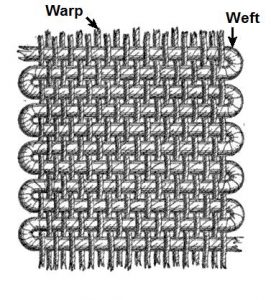
The Chinese character for sacred text (jīng, 經) shows silk (糹) with a river flowing down (巛) from Heaven (一), and the character for work or practice (工). Sacred texts such as the Dao-De & Zhou-Yi have a vertical quality of revelation – flowing down from Heaven. Jings are thus considered “warp” (縱) texts – referring to the vertical strands in a loom. Weft (橫) strands snake horizontally through the warps to tie them together and complete the fabric. In Daoism, “weft” texts are not scriptures but works like commentaries that allow us to work with the jings and cross-thread them with one another.
My wuweidao lineage teacher, Liu Ming, insisted that the Dao-De is a manual for meditation, but it needs to be “opened up” for us by a person who is “in the practice” of non-conceptual meditation. Otherwise, it is warp without weft, an incomplete fabric. This is what we do in our Wuweidao Cultivation Group – give our participants a fresh translation along with a look at the Chinese etymology of the warp, along with a weft commentary to connect Laozi’s teaching with the actual practice of meditation.
Similarly, this 60-moon observation is tying together the warps of the Heavenly Stems & Earthly Branches with the separate warp of the Zhou Yi hexagrams to obtain a meaningful image of the qi-quality of each moon – a weft enabling us to work more effectively with either warp.
Check out Stephanie’s loom below! And I suggest you take a moment to appreciate some of her works at: www.stephaniehoppe.com.
