
Category: Translations
Protected: Dao De Jing Chapter 47
Protected: Dao De Jing Chapter 20
Protected: Dao De Jing Chapter 19
Protected: Dao De Jing Chapter 37
Protected: Dao De Jing Chapter 71
Trusting the Heart Inscription (Xìn Xīn Míng 信心銘)
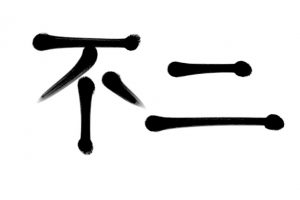
Allow me to share this wonderful text attributed to Sēngcàn, the 3rd Chinese Zen Patriarch, who lived in the Sui Dynasty prior to the heyday of Zen, which is generally accepted to have been the Tang & Song Dynasties. This text has Laozi running all through it. The Chinese appears to be written for recitation or chanting, however it’s not easy to make the English read smoothly from couplet to couplet. I’ve done my best and I think it’s good enough. Wuji & Taiji together: “Not-Two!”

Accessing Dao is not difficult
just don’t pick & choose
Without like & dislike
the chamber is naturally clear & bright
But make the smallest distinction
and set apart Heaven & Earth
If we wish to perceive the Original
don’t keep for & against
For & against mutually contend
serving to afflict the heart
If we don’t understand this mysterious point
it is futile to seek tranquility
Complete union with supreme emptiness
is without deficiency, without excess
But choose to accept or reject
then it is not so
Do not pursue entanglements
yet don’t dwell stuck in vacuity
Cultivate Oneness with a peaceful heart
thusly obliterating self-exhaustion
Stilling movement to return to stillness
only generates more movement
Only stuck in two sides
we cannot know cultivation of Oneness
Not accessing cultivation of Oneness
dwelling in duality, we forsake merit
Denying existence, we drown in existence
succumbing to vacuity, we get stuck in vacuity
The more we talk, the more we think
the further we wander astray
Cut off talking, cut off thinking
then there is nowhere we cannot access
Return to the root and get the point
but pursue appearance and lose the lineage
In a flash return the radiance
and successfully transcend vacuity
Transcending vacuity, shift & transform
with each & every fantastic appearance
It is no use to seek reality
just wait for appearance to cease
Dwell not in dual appearance
carefully avoid chasing & seeking
Make right & wrong
and the heart gets lost in confusion
Duality comes from the One
the One does not guard itself
The heart of the One is unborn
ten-thousand dharmas are no hindrance
No hindrance, no dharmas
no birth, no heart
“This” surrenders when “that” is extinguished
“that” is banished when “this” drops
“That” depends on “this”
“this” depends on “that”
If we wish to know these two
their origin is vacant Oneness
In vacant Oneness these two are equal
together they contain ten-thousand forms
Do not distinguish coarse & fine
extinguish one-sided views
The great Dao has a wide body
not easy, not difficult
Small views deceive like a fox
they wander quickly yet respond late
Grasp them and lose our parameters
certain to enter deviant ways
Just let things be as they are
and the body neither departs nor abides
Trust our nature to merge with Dao
at ease, troubles disappear
Overly studying distorts reality
sinking into dimness and ineptitude
It is inept to labor the spirit
Why neglect our kin?
If we wish to obtain the One Vehicle
do not dislike the Six Dusts
Not disliking the Six Dusts
stay aligned with correct awareness
Sages stay with wuwei
fools bind themselves
Dharma is not some unusual dharma
it is fantasy to cherish anything
Stirring up the heart’s desire
is this not a great mistake?
Confusion gives birth to isolation and upheaval
awakening is without good & evil
Every “thing” has two sides
overflowing beyond the brim
Dreams, illusions, vacant flowers
why labor to grasp them?
Gain & loss, right & wrong
release them at once
If the eye never sleeps
all dreams dissolve of themselves
When the heart makes no distinctions
the ten-thousand dharmas are as One
As the One Original Body
sever and forget all karmic entanglements
View the ten-thousand dharmas as equal
reverting and returning of themselves
Thereby obliterating their position
unable to hold to their locale
Stilling movement, there is no movement
Moving stillness, there is no stillness
Without the presence of duality
how can the One thusly exist?
In the end, all extremes are exhausted
nothing survives this path
Commit the heart to equanimity
and all phenomena come to rest
Foxly deceit is purged and exhausted
restoring trust and rectitude
Every “thing” doesn’t last
losing all recollection
Empty, bright, self-illuminating
no labor of the heart
Not dwelling on any thoughts
knowledge & emotion cannot fathom this
In the true Dharma realm
there is no self, no other
If we want immediate accord
just say “not-two”
In “not-two”, everything is the same
nothing is not contained
Sages of the ten directions
all enter into this lineage
The lineage does not rush or delay
one moment’s thought is ten-thousand years
Nothingness is located nowhere
pervading the ten directions, yet right before our eyes
The extremes of small & large alike
sever and forget all distinctions
The extremes of large & small alike
see no borders manifest
Existence is nothingness
nothingness is existence
It may seem not so
but we must not hold onto appearance
One is everything
everything is One
So surely indeed
why worry without end?
Trust the heart to “not-two”
as not-two trusts the heart
Words and speech sever Dao
it is not going, coming, or present
Translation by Nameless Stream (無名川), 2019
Protected: Dao De Jing Chapter 53
Protected: Dao De Jing Chapter 21
Protected: Dao De Jing Chapter 12
Xing Qi (行氣) Jade Inscription


行氣
深則蓄 蓄則伸 伸則下 下則定 定則固 固則萌 萌則長 長則退 則天
天機舂在上 地機舂在下 順則生 逆則死
Circulate qi
Deepen then store
Store then expand
Expand then descend
Descend then stabilize
Stabilize then densify
Densify then sprout
Sprout then grow
Grow then withdraw
Then Heaven
Heaven pivots up
Earth pivots down
Comply then live
Oppose then die
Commentary
Check out this old piece of jade inscribed with a pithy guide to qi-cultivation from the Warring States period, around the time of Laozi. It seems to have been some kind of pendant or a knob on a staff. The inscription describes the process of internal qi-cultivation and warns of the peril of improper practice. Chances are this piece was transmitted along with detailed oral guidance. This inscription is considered one of the oldest artifacts evidencing qi-cultivation, and I would also say it pretty clearly addresses the process later known as Neidan (internal alchemy), as it succinctly describes the alchemical process. Many of the characters are also used by Laozi and later Neidan texts. While it could be that this guidance was written specific to a particular practitioner, it appears general enough to apply to all practitioners.
As per traditional writing, the characters start at the upper right and go downward, the columns then proceeding to the left. The two short horizontal lines (meaning “two”) at the lower right of many of the characters are doubling marks, used in Zhou-era script to indicate repeating the character. The stone is cut into twelve sides, with three characters on each side – so there’s a total of 36 written characters, however including repeated characters there are 44 (yikes! an inauspicious number, perhaps this is why doubling marks are used). I have rendered the characters horizontally from left to right, have inserted the repeated characters, have inserted spaces between phrases, and have broken it into three sections. Let’s look at each phrase in detail as it relates to our practice of Zuowang & Neidan.
Circulate qi (xíng qì, 行氣)
This first phrase serves as both the title of the script and its first line. Xing (行) means to move or circulate – this is the character used for the Five Elements or Phases. Qi (氣) here may apply to moving or sitting practices alike. Whether moving or still, qi circulates. While we may interpret this and each subsequent phrase as instruction for what we “ought to do”, in our tradition of wuweidao we view this inscription – as well as most Neidan instruction – as describing what happens effortlessly of itself when we just “sit & forget” regularly over a period of time. Correct circulation of qi is the natural function of Dao, we don’t need to make happen through effort or intention. Yet guidelines for correct circulation are invaluable, given human beings’ tendency to mismanage our qi.
Deepen then store (shēn zé xù, 深則蓄)
Regular qi-circulation deepens (深) the qi, just as water flowing in the same place over time cuts a channel in the earth. In both Zuowang & Neidan, the qi turns inward, going deep into the dantian. While this inward shift isn’t about strenuous effort, we do need to give it the chance to happen – this is the whole purpose of formal practice. Otherwise the “deep channels” manifest as karmic entanglements thieving away the qi. Such thieving and qi-mismanagement is addressed in important Daoist texts such as the Yinfu Jing & Qingjing Jing.
“Ze” (則) refers to sequencing – this, then that. While we could approach these sequences by deliberately shifting gears in practice, our tradition reads these transitions as natural progressions of a single practice, not instigated by intention.
So, just like water flowing into a pool, as we let the qi flow deep inside, we naturally store (蓄) it up.
Store then expand (xù zé shēn, 蓄則伸)
As we store up the qi, of itself it expands (伸), just as water in a pool rises higher & higher. This expansion exerts a positive pressure in every direction.
Expand then descend (shēn zé xià, 伸則下)
As the qi expands, it naturally becomes both heavier & lighter at the same time, exerting more pressure downward (下) at the base of the channel even while feeling freer to roam. One thing we want to watch for here is that the expanding qi doesn’t just float away. Keep it down.
Descend then stabilize (xià zé ding, 下則定)
As we let the qi sink – and let it keep sinking & keep sinking – it becomes stable (定). Ding is the term used to translate the Buddhist word “Samadhi”. But for Daoists it’s more about stabilizing qi rather than fixing the mind. The Tang Dynasty scriptures Dingguan Jing & Zuowang Lun go into more detail about the process of stabilization. Ding is also a homophone for cauldron, a Neidan reference to the lower dantian.
Stabilize then densify (dìng zé gù, 定則固)
As we continue to abide sunken and stable, the qi of itself becomes very, very dense (固). As though the entire universe is being compressed into a single point. But this is not about strenuous focus! The body remains limber and at ease, the mind remains calm and open. At this point not only do we feel the lower dantian densifying, we may also feel it in the bone marrow throughout the entire body. Deep, stable, dense.
Densify then sprout (gù zé méng, 固則萌)
This densification causes a kind of grinding feeling that excites an internal movement like a pressure cooker – referred to here as sprouting (萌). Sprouting might manifest as subtle internal thunder or jerking spasms in the torso or limbs, as we are talking about a lot of power here. These spasms may have a blissful quality as this is an internal stirring of jing (embodiment-essence). This is where keeping our practice effortless and natural is really important. It’s also important that we not actively try to sprout the qi – the emergence of young yang happens of its own, inevitably, if our densifying practice is correct. Zhang Boduan, in his seminal Song Dynasty Neidan work, Wuzhen Pian, referred to this stage as the emergence of the Mysterious Pearl. Precious.
Sprout then grow (méng zé zhǎng, 萌則長)
If we stay with this cultivation as described above – and don’t let the sprouted qi spill outward too much – the sprout grows & grows (長). This character has a homograph that means constancy, but I think grow is meant here as it follows sprouting. But this is not an external expansion – it is growing in an internal direction. And rising upward from a stable base.
Grow then withdraw (zhǎng zé tuì, 長則退)
As the sprout grows inward & upward, eventually it reaches the mountain peak. This means withdrawing (退) from manifestation. This character includes the radical for movement (辶) as well as the 7th trigram (艮, ☶) – so we can literally translate it as the qi “goes to the mountain”. Mountain refers to the baiwei at the top of the head. The character for mountain shows an eye gazing inward – suggesting the practice of neiguan (inner observation). “Going to the mountain” is also a term used for going on retreat or becoming a monk.
Then Heaven (zé tiān, 則天)
I’m not sure why the character for withdraw isn’t repeated here – it may be due to a rhyming pattern. Most translators add it in. As the qi withdraws to the mountain, it reaches the sky. Heaven (天) doesn’t really mean the manifest sky but rather the pure yang creative force referenced in the Yijing. This ascension is not like strenuously climbing a steep staircase – it is rather like rising mists that float effortlessly upward when conditions are correct.
Heaven pivots up (tiān jī chōng zài shàng, 天機舂在上)
Earth pivots down (dì jī chōng zài xià, 地機舂在下)
These lines are tricky to translate. It’s not just “Heaven is above, Earth is below.” 機 is a mechanism or pivot (the character suggests a sharp wooden tool and is an important term in the Yinfu Jing); 舂 means to grind in a mortar. So we can say Heaven processes things upward (上), Earth processes things downward (下). I think the meaning here is that returning to Heaven “hinges” on the process outlined above.
Comply then live (shùn zé sheng, 順則生)
Oppose then die (nì zé sǐ, 逆則死)
Following (順) the process outlined above leads from Earth (pure yin) to Heaven (pure yang). Returning to Heaven means eternal life (長生) – but it’s important to understand that we are not talking about enabling our emergent identity to last forever. As Liu Ming says: “an immortal self would be like eternal pollution.” Immortality (仙) refers to a person who has withdrawn to the mountain – the character shows a person (亻) and a mountain (山).
Opposing (逆) this process leads to certain death (死) – ever disconnected from Heaven. The Yinfu Jing & Qingjing Jing further address these perils.
These lines resonate with Laozi’s saying “the sage leaves that and takes this” from Dao De Jing Chapter 12. This is the basis of precepts in Daoism – parameters for correct practice and qi-management. By correct, we mean natural alignment with the Dao of Heaven.
This twelve-sided stone includes pithy, simple guidelines – yet quite a bit more complex than our instruction in Zuowang. We don’t need to remember all this. But we do need to make sure our practice is correct. It’s not really enough just to sit without some sense of what happens when the qi is cultivating properly. This is where some engagement in Neidan teaching & practice can be really helpful for Zuowang practitioners. It’s also a good idea to engage in discussion with experienced practitioners about what is happening with our practice. I hope this work helps to illuminate what is happening with the qi in your practice.